National Alliance for the Regenerative Vegetable Oil Sector (NARVOS)
The National Alliance for the Regenerative Vegetable Oil Sector (NARVOS) has been established under the EU–India Partnership Programme on “Promotion of Regenerative Agriculture Practices for a Food-Secure and Climate-Resilient Future.” It serves as a dedicated, strategic platform to advance the programme’s objectives within the vegetable oil sector.
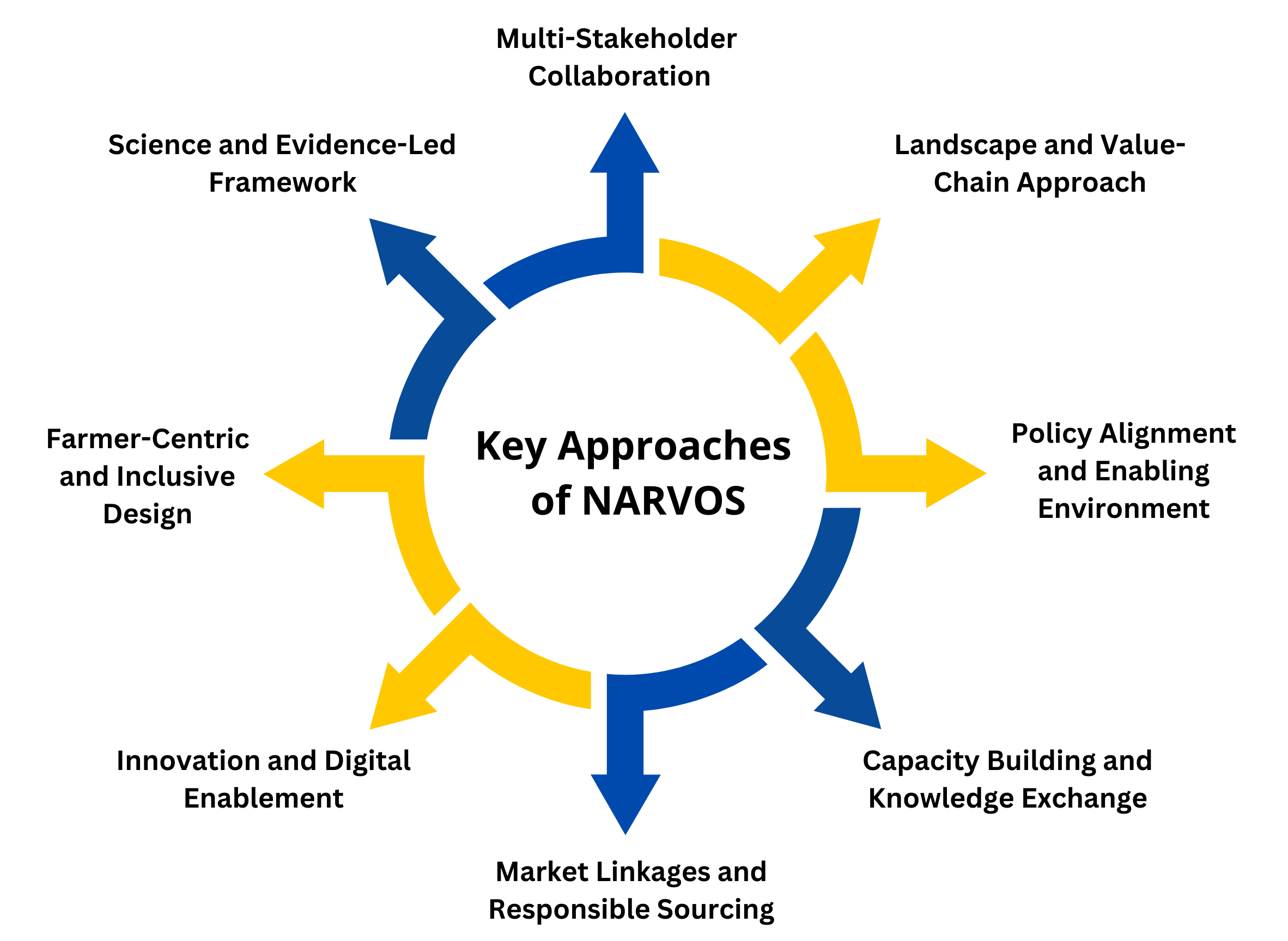
NARVOS is not a parallel initiative; it is a core implementation and coordination mechanism designed to translate the programme’s vision into tangible, sector-wide action. The EU–India Partnership Programme places strong emphasis on scaling regenerative agriculture through multi-stakeholder collaboration, policy integration, and market alignment. Achieving this at scale requires a focused, sector-specific institutional platform—one that can bring together farmers, industry, researchers, civil society, and policymakers within a shared framework.
NARVOS fulfils this critical role by providing the institutional architecture needed to align field-level regenerative practices with structured supply chains, evidence generation, and policy processes. By anchoring regenerative vegetable oil initiatives within a unified alliance, it enables systematic coordination, shared learning, and collective decision-making, ensuring that outcomes are scalable, measurable, and sustainable.
Acting as a bridge between on-ground implementation and policy mainstreaming, NARVOS supports the institutionalisation of regenerative agriculture within national strategies and market systems. Through this approach, the alliance ensures that regenerative practices move beyond pilot projects to become integrated, long-term solutions that strengthen food security, enhance climate resilience, and improve farmer livelihoods.
About Founding Members
The strength of the National Alliance for the Regenerative Vegetable Oil Sector (NARVOS) is rooted in its diverse and strategic founder members. Together, they bring complementary expertise across sustainability, research, policy, and industry—creating a powerful coalition to drive large-scale transformation of India’s vegetable oil sector.
Solidaridad
Solidaridad, the lead partner of the EU–India Partnership Programme “Promotion of Regenerative Agriculture Practices for a Food-Secure and Climate-Resilient Future,” plays a catalytic role in shaping and anchoring the NARVOS platform. With over five decades of global experience in sustainable agriculture and supply chains, Solidaridad works with millions of farmers worldwide to promote regenerative practices that enhance productivity, resilience, and livelihoods.
In India, Solidaridad has been instrumental in convening stakeholders across commodities and value chains, creating an inclusive platform where farmers, industry, policymakers, and civil society collaborate to scale regenerative agriculture in a structured, evidence-based, and outcome-driven manner.
Centre for Responsible Business (CRB)
The Centre for Responsible Business (CRB) brings deep expertise in responsible business conduct, sustainability frameworks, and policy engagement. Within NARVOS, CRB plays a critical role in aligning regenerative agriculture with corporate responsibility, market incentives, and national sustainability priorities. Its engagement helps ensure that regenerative practices are not only environmentally sound, but also economically viable and institutionally supported.
Centre for Advanced Research & Development (CARD)
The Centre for Advanced Research & Development (CARD) strengthens NARVOS through its focus on research, evidence generation, and field-level innovation. By supporting data-driven insights, pilot interventions, and impact assessments, CARD helps translate regenerative agriculture principles into measurable outcomes—particularly in areas such as soil health improvement, input cost reduction, and climate resilience.
Industry Leadership: SEA and SOPA
Industry leadership within NARVOS is provided by the Solvent Extractors’ Association of India (SEA) and the Soybean Processors Association of India (SOPA), which together represent a significant share of India’s edible oil processing and trade ecosystem. With India importing nearly 60 percent of its edible oil requirements, the engagement of these apex industry bodies is critical. SEA and SOPA play a pivotal role in mobilising industry participation, promoting sustainable sourcing, and linking regenerative production systems with markets—thereby enabling scale, traceability, and long-term sector-wide impact.